To monitor each group member's progress I created a document which outlines each task that needs to be completed weekly and a system where completed tasks can be checked off. I also used this document to record any meeting notes and tasks group members needed to complete for the next week.
For our communication system, our group has already set up a Whatsapp group at the start of the school year where we already have been communicating regularly. I will make good use of this group to remind group members to complete work and make sure everyone knows what they are doing.
Before I began, I reminded myself the difference between an aim and an objective. An aim is something general, broad and strategic whilst an objective is something that is specific, clearly defined, and allows the aims to be achieved.
My Aims and Objectives:
Leadership
Aim: To be a fair leader that group members find approachable
Objectives:
To listen to everyone during group discussions
To respect all group members' opinion
To calmly resolve any disagreements and make sure that the group reaches a consensus
To give fair feedback to each group member
Communication
Aim: To keep in touch with group members and monitor their progress
Objectives:
To be active in the Whatsapp group chat
To make sure each group member understands their task and feels comfortable to ask for help
To set up a planning document where each group member's task for each week is clearly set
Management
Aim: To produce a documentary of good quality that meets the assessment criteria
Objectives:
To regularly check that the work being produced fits within the assessment criteria
Use a range of primary and secondary sources
Organise interviews with organisations and professionals
Collect relevant facts and statistics from reliable secondary sources
Work with the editor to make sure the technical side of the documentary is completed well
Work with the production technician to check that all footage is filmed in an appealing way
Work with the information designer to ensure that all graphics created are relevant
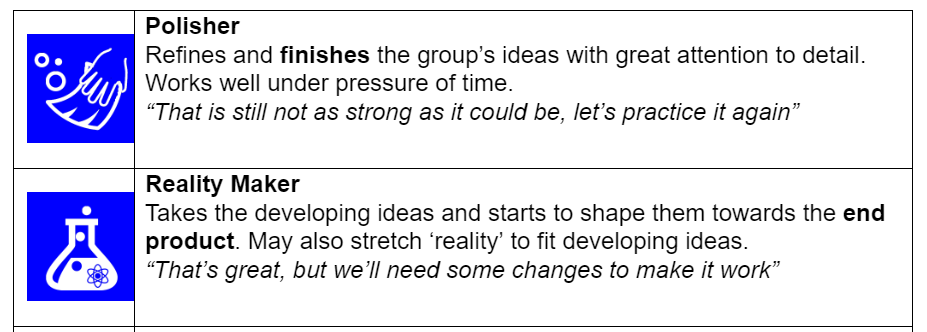
Collaborative Disposition
3 dispositions that I am currently good at:
3 dispositions that is important for my role:
3 dispositions that I need to work on:
Collaboration Objectives
After reading the collaboration skills framework, I feel that I am able to speak up during discussions and accept responsibility well. However, I sometimes do not give sensitive feedback but rather offer rather blunt comments. I am always willing to lead and help the group achieve its aim by making sure everyone is heard.
1. To demonstrate conflict-resolution dispositions, such as the harmoniser when necessary
2. To always put myself in others' shoes in order to show sensitivity to group members' feelings
3. To lead by example, such as making sure I always meet deadlines and pay 100% effort to all the work I do
4. To ensure that group members all contribute even amounts
Communication Objectives
1. To ensure that the information in the video is not too complex so that the audience can stay engaged
2. To use literary conventions in voiceovers, such as rhetorical questions or imagery
3. To organise the media in the documentary well so that the audience can follow through and in the end, be informed of our topic
Evaluating is a process of assessing how far your work has met or exceeded the objectives created at the start of the project. You should use your objectives as the structure of your evaluation. Your objective should be the sub-title and then you can start talking about the strengths and weaknesses about the way you met this objective in your work. After this, you should also discuss and suggest actions or ways for improvement. (From ISLE resource- linked here)
My Aims and Objectives
1. Interview Filming
Aim: To film an interview in a way that can show my technical competencies and appeal to the audience
Objectives:
Use a variety of shot angles effectively like wide, medium, close-up etc.
Strength: Achieved this successfully during the filming of my b-roll because I shot a few of each shot
Weakness: Not all my shots were included in the final video so therefore, there were only establishing, wide and mid shots
Actions for the future: Maybe should have urged the editor to include more shots instead of just leaving it be
Compose my shots using the rule of thirds
Strength: Was 100% successful in composing my A-roll in the rule of thirds
Weakness: Not all of the b-roll was composed using the rule of thirds at appropriate times
Actions for the future: Maybe should have reshot the b-roll footage in the correct composition
Film using a tripod so that all footage will be steady
Strength: Was able to use a tripod for all shots, interview footage was completely steady
Weakness: Although a tripod was used, most b-roll footage wasn't steady because I was moving the tripod which was a bit redundant
Actions for the future: Could have replaced it with steadier shots or should have found a way to work around the issue of the shaky footage
Film in a quiet place so that there will be close to no background noise
Strength: Pretty successful because although there was a bit of static-like background noise, the audio was still clear
Weakness: A bit of static-like background noise
Actions for the future: Maybe change the position of the microphone or change the type, e.g. use a lavalier microphone so it will be closer to the subject
Have appropriate headroom in footage
Strength: I think this was achieved perfectly
Weakness: /
Actions for the future: /
Ensure the audio in the interview is usable and clear
Strength: Again, I feel like this was achieved close to perfectly
Weakness: A bit of static-like background noise
Actions for the future: /
Make sure the interviewee is not looking directly at the camera
Strength: Achieved perfectly
Weakness: Although this objective was achieved, I didn't pay attention to the leadroom
Actions for the future: Shifted the camera a bit to get enough leadroom, pay closer attention next time
Have the correct settings (white balance, exposure, contrast) on my camera/phone
Strength: I think this was achieved excellently during the A-roll
Weakness: Some parts of the b-roll that was a bit underexposed (when I changed the angle during a shot, the exposure didn't change in turn)
Actions for the future: Paid attention to this during filming and I should have reshot this
2. B-Roll Filming
Aim: To make the video more engaging and appealing using B-roll footage
Objectives:
To film B-roll in suitable and topic-related places: e.g. the sea
Strength: I got a few shots of the ocean, and lots of footage on the interview day
Weakness: These shots weren't in the final video because we sourced better videos of real dolphins from the internet
Actions for the future: I think if my own shots were of a high quality as well, then they would have been included too so perhaps I should have took better footage
To vary the amount of B-roll and A-roll footage in the final video
Strength: I think this was achieved well
Weakness: Some b-roll could have been added during the interview
Actions for the future: Advise the editor to do so next time
Use a variety of shots and angles during the filming of B-roll
Strength: Succeeded in this
Weakness: Shots weren't very steady, the speed of the movements weren't constant, could have tried more techniques like pull focus
Actions for the future: Tried new angles, reshot footage or found a way to make the camera movements smooth
Have the correct settings (white balance, exposure, contrast) on my camera/phone
Strength: Close to perfect in achieving this goal- I always remembered to set my exposure manually
Weakness: Did not attempt to experiment with the white balance (although it was already correct), some shots were slightly underexposed
Actions for the future: Avoid shooting in places with high contrast or strong shadows
Avoid shaky or blurry footage
Strength: Had steady footage during all of a-roll
Weakness: B-roll wasn't always steady
Actions for the future: Replaced it with steadier footage
3. Organization and Preparation of Equipment
Aim: To have the correct equipment that is of high quality and will be able to take high-quality footage
Objectives:
To follow my pre-filming checklist
Download the recommended app and use it
To have and use a tripod
To have and use a filming camera that will be borrowed from the school (or phone)
To have and use a microphone (possibly a lavalier) that will be borrowed from the school
To use the microphone in close proximity and obtain clear audio
If equipment needs to be borrowed from the school- make sure to book it earlier and that it is available for use
Strength: I followed my pre-filming checklist, used a tripod, used a high quality filming camera, used a microphone in close proximity, was able to get clear audio and used the recommended app at times to film some B-roll
Weaknesses: I don't think this can be called a weakness but I didn't use the equipment from school since our interview was at half-term and before we were taught how to use the school equipment so instead, I had to use my own equipment.
Actions for the future: Maybe should have tried to use the school equipment as well (?)
4. Audio Recording
Aim: To always have clear audio throughout the whole video
Objectives:
To always record in a quiet environment
Strength: Done so in the interview- it was in a quiet office with no one else
Weakness: Altough it was a quiet environment, there was still some background noise
Actions for the future: Could have also tried closing all doors as well as windows to reduce as much background noise as possible or could have used a program to process the audio in order to remove the background noise
To use microphones while filming most of the time
Strength: Succeeded in this
Weakness: /
Actions for the future: /
To record in close proximity
Strength: Succeeded in this
Weakness: /
Actions for the future: /
If doing voiceovers, make sure the speaker is loud and clear, so that it can be of the best quality possible
Strength: All the voiceovers were loud and clear which was good
Weakness: The volume of the voiceovers were varied so some sounded a bit louder than others
Actions for the future: Rerecorded those voiceovers that were a bit too soft or loud in order to get the best result
I think the biggest problem I had was the B-roll. Since our topic is about dolphins, the best possible B-roll we could get is obviously footage of dolphins. However, dolphins are a very rare sight and even harder to shoot. Therefore, we had to resort to footage from the internet.
Please look at the previous blog post for the analysis of my creative decisions in the B-roll footage. Read on for the analysis on the A-roll!
All the A-roll in the video that I have taken (interview) is from 1:48 - 2:57.
Throughout this whole shot, I have utilised the rule of thirds well because the interviewee (Yuki) is placed exactly where the line is. I shot it in a mid-shot- meaning that most of her upper body can be seen so that she isn't cut off and it is more comfortable for the viewer. The angle I shot it in is just at eye-level, which is a netural angle because I don't want to make her seem more or less powerful using a high or low angle. I gave it all enough headroom so the subject doesn't feel squished and the viewer will find it comfortable to watch. However, I feel as if I could have given it more leadroom by moving the camera slightly to the right. This is because I advised her not to look directly at the camera (something we have learnt) so instead her eyes are looking to the right. Therefore, if the camera was moved a bit right, the shot would have been even better.
The only big problem I have about this is the quality of the footage. For some reason, the quality has dropped immensely as compared to the raw version which you can find in this folder. Therefore, it has made the whole clip look slightly blurry.
Full Analysis
Is your footage steady?
I think my A-roll footage is extremely steady. This is because I used a tripod in the whole interview and didn't move it once after I set it up correctly. However, if you watched the full raw version, you would see that I had to shift the camera slightly at one part which made that part of the footage a bit unsteady.
Is it well composed with adequate headroom and lead room?
As mentioned in my paragraph above- I think there is enough headroom but a bit more leadroom is needed. To improve the leadroom, I should move the camera slightly towards the right in order to where her eyes are leading to.
Is there a variety of shots?
In the A-roll, I cannot say that there is a variety of shots because it is just one full shot with no movement etc. The lack of movement and angles is compromised in the B-roll. In terms of content, I think there was "too much" variety because the background was pretty messy which could have distracted the audience. Although I did notice this whilst filming, I didn't raise this issue up because I didn't want to be impolite or picky. Therefore, the next time I film, I need to make sure that I have a quiet background in terms of mess and noise.
Did you manually set the exposure, white balance and focus to get a good shot?
Yes, before filming, I touched the settings in order to get the exposure right- there was natural sunlight coming in from the window opposite which aided the exposure. I think the shot was at a correct exposure because it wasn't under or overexposed at any time. I did not change the white balance on my camera because it was already on the correct setting- this is why the shot does not look tinted yellow. I switched my focus to auto-focus because as mentioned during my b-roll analysis, I think changing the focus is risky and might lead to a bad shot in general.
Did you remember to use the rule of thirds sometimes to help you frame the shot?
I used the rule of thirds during the whole shot. I find this rule to be almost natural by now since it is very simple and easy to get right. I think I could have improved the composition a bit by making her eyes at the rule of thirds gridline instead of hter body at a whole.
Can you hear what is being said?
Yes I can definitely hear what is being said clearly although I feel like it is a bit muffled at some places. I used a shotgun-like microphone which I attached onto my camera- it was a close proximity, dynamic microphone. I think this was very effective because I didn't catch any background noise and the audio was clear.
Did you use any interesting camera angles or camera movement? Was the camera movement smooth?
As this was just one whole still shot, I did not have any angles or movement.
B-Roll is footage that you take in order to intercut the main footage. This footage is usually supplementary footage that is related to the A-roll and is used to give more insight into the topic. Whilst shooting B-roll, you should always:
1. Start with a wide lens that should show the exterior of the building- this is usually a tilt or a pan
2. Shoot a scene where the subject is walking into the building- let him/her walk in and out of the frame and pan the camera across quickly
3. Try to use different angles: shoot high and low angles when you are in an interior space
4. Use different camera movements like panning, sliding and tilting
5. Avoid bright windows, and try to shoot where you can give your subject a lot of space
6. Consider your background: try to change the focus from the foreground to the background and vice versa
7. Take shots without a lot of talking or conversation because it will be more useful after
8. Don't lose important scenes! Just shoot and don't change exposure settings whilst shooting
I think the example in the video below was a good insight into what a good documentary type video should look like. Firstly, it included excellent quality B-roll which were all steady shots, included a variety of angles and gave us further insight into the work the interviewee does. The B-roll was also directly related to what the interviewee was saying at all times.
Dolphins- probably from the internet or our charity's Facebook page
Shots of us going to our interview- panning of walking
Charity's office and building- establishing shots
Maybe litter on beaches?
Folder with all the B-roll taken on our interview day and other times of the HK oceans
Evaluation of the B-roll in the video
0:00 - 0:04, 0:11 - 0:21, 1:02 - 1:09, 1:19 - 1:21, 2:58 - 3:21: This B-roll was found on YouTube from National Geographic, we used this because we couldn't shoot any footage of dolphins
0:22- 0:27: This B-roll was found on YouTube again and it is originally from RTHK on their documentary about saving the Chinese white dolphins
0:59 - 1:01: This short clip was taken when we were walking to our interview
1:35 - 1:44: These clips were taken when we were going to our interview
All other short clips of B-roll were mostly pictures that we sourced from Google Images
In the short clips I took, I think that the camera work was not extremely stable but still at an acceptable level. I included techniques I have learnt like panning and tracking, whilst also trying to maintain a rule of thirds although it wasn't really obvious. My b-roll clips did not include any sound. However, if you look in the folder, I think I took some creative shots of basic things like the lift doors opening with the subject walking out, the lift display moving, zooming into street signs etc. but these weren't included in the final video. Most of our b-roll had to be sourced from the internet because we weren't able to take clips of actual dolphins.
Full Analysis
Is your footage steady?
As mentioned, I think my footage wasn't extremely steady. Although I did use a tripod during the whole filming process, whenever I touched the tripod or had to move it in order to give some movement to my shots, the camera would shake a bit. I think I could have avoided this issue if I took longer shots so that there would be less shaky footage to work with. Another method would be to use a heavier tripod that would not move as easy.
Is it well composed of adequate headroom and lead room?
I don't think headroom and lead room is relevant in terms of B-roll for our video. However, there were a few shots with the group members walking and in those shots, there was enough space around each person for the viewer to feel comfortable.
Is there a variety of shots?
In the video, there wasn't much variety in the shot I took because most of it was either establishing shots or mid-shots with a bit of panning and zooming in. However, if you look in the folder, you will be able to see that I had many close-ups, and a few long-shots of the scenery around (I wasn't able to control what the editor decided to put in the video). In terms of the content, I think I had a lot of variety because I took basically everything- the sky, the exterior of the building, the interior, street signs, the lift, the office but most of it wasn't included in the video (I had no control) which is a shame.
Did you manually set the exposure, white balance and focus to get a good shot?
My camera was set on aperture priority mode so yes I technically did set the exposure myself in all the shots. I didn't touch the white balance much- meaning that I just kept the settings that I made when I last touched my camera. For focus, I put it on autofocus because I know that this is a function that is messy to play with because I might forget to focus it properly or the focus will be incorrect which will ruin the whole shot. That is why I did not take the risk and just set my camera on autofocus.
Did you remember to use the rule of thirds sometimes to help you frame the shot?
This was one of the things that I always remembered to do- this is evident in the shot with us walking. I had more evidence of this in my other shots but again I didn't have control on what was included in the final video.
Can you hear what is being said?
All the audio from the b-roll was removed so this is not applicable.
Did you use any interesting camera angles or camera movement? Was the camera movement smooth?
I used a variety of camera angles and movement but I wouldn't call them special in any way. I think it definitely did make the whole shot look more interesting as compared to a still shot. On the other hand, I think I need to work on my camera movement because I found keeping the speed constant really hard. Therefore, you can see that whilst applying camera movement, the shots weren't entirely steady. This is something I need to improve on if I ever do this again.
In order to practice filming for the interview, we had to imagine we were filming a documentary in Island School. This included working in teams of two and filming A-roll footage of an interview and B-roll footage of the school. The shot list and instructions we were given were as follows:
Check and set the focus, white balance and exposure manually for each shot
Check the sound recording quality and level before filming the interviews
A-Roll
For the A-Roll interview, we had to interview a teacher with the question of "What do you like about working at Island School?" We chose to do our interview with Daniel in the office.
In order to get an interview of high quality, we had to set up our camera- which was my phone, place it on a tripod to get stable shots and then to use the i-rig mic in a position where it picks up a good quality sound. Moreover, we also had to use our knowledge collected over the past few weeks- framing our shots using the rule of thirds, having sufficient head and lead room, make sure the environment is not noisy visually and audibly.
I think this short interview went well because we incorporated the rule of thirds, had clear and audible sound, and basically achieved our goals.
B-Roll
Next, we had to film some B-Roll footage. The shot list was as follows:
Three 4 second establishing shots of different parts of the school entrance
Three 4 second interesting long shots of the school architecture at different angles
Three 4 second interesting close-ups of the school architecture at different angles
A 4 second long shot of the school office
Two 4 second establishing long shots of the same classroom
Two 4 second mid shots of students working
Two 4 second 2 close-ups of students working
To make sure we had high-quality B-roll footage, we still filmed with a tripod so that the shots would be stable. We also manipulated the exposure whilst filming: for example, when we were in the office, we turned the ISO up a bit and when we were outside, we lowered the ISO to complement the natural lighting we had. We also didn't just film still shots but include techniques like panning, tracking, tilting and zooming in.
Here are the clips: Three 4 second establishing shots of different parts of the school entrance:
Three 4 second interesting long shots of the school architecture at different angles
Three 4 second interesting close-ups of the school architecture at different angles
A 4 second long shot of the school office
Two 4 second establishing long shots of the same classroom
Two 4 second mid shots of students working
Two 4 second 2 close-ups of students working
Overall, I think today was a valuable learning experience because it allowed me to learn and practice using the filming equipment provided by the school. Although I actually have already gone to our interview, we might go to another one and so, I will be able to use the skills I have learnt today.
Here is the final edited video of all the film clips edited together:
Evaluation:
Is your footage steady?
I think some of the B-roll footage isn't extremely steady but the interview footage is 100% steady because I used a tripod whilst filming. Although whilst filming the B-roll, I was also using a tripod but the tripod wasn't still.
Is it well composed of adequate headroom and lead room?
In the interview, it was framed well so therefore, the whole picture did not feel cramped.
Is there a variety of shots?
Yes, I used establishing shots, long shots, close-ups and mid-shots each with different angles (high, low etc.). Furthermore, I did more than still shots but included techniques like panning, tracking and zooming in.
Did you manually set the exposure, white balance and focus to get a good shot?
This was not done in the interview because everything was set to auto. However, whilst filming the B-roll, we did manually set the exposure and focus because this had to be changed each time we changed the setting. For example, when we were in the classroom, we turned the ISO up a bit because there is less natural lighting.
Did you remember to use the rule of thirds sometimes to help you frame the shot?
Yes, this is illustrated in the interview. Our interviewee was placed where the rule of thirds line is and he wasn't looking directly at the camera either. For some of the B-roll, when there was a person present, I also tried to use the rule of thirds but at these instances, they aren't as obvious as the interview.
Can you hear what is being said?
Yes, I think the audio in the interview is of excellent quality because there was close to none background noise. Firstly, this is because we were in a quiet environment and secondly, it is because we used an i-rig microphone that picked up the sound well.
Did you use any interesting camera angles or camera movement? Was the camera movement smooth?
I wouldn't necessary call my camera angles and movement as interesting but I think I quite liked the movement during the shots taken at the front entrance. I also think that my shot of Block 3 that I took from the roof was pretty cool because it gave us a different view/angle to the school. I think that at times, the camera movement wasn't very smooth but mostly, it was quite steady and smooth- there weren't any really stuttery bits that stood out.