Friday, February 22, 2019

Script Planning

Script Planning

Before I developed my script, I looked into the narrative structure and how a documentary should be structured in order to effectively convey the message. 

These are some of my notes after looking at the resources provided:
Video
- Act 1, the set-up and contains the inciting incident 
- Act 2, the longest act of the film and contains the conflict
- Act 3, the shortest act and contains the suspenseful climax
- Denouement, the ending

Presentation
- The Tease- introduces main characters, establishes a setting, presents a question
- The Body- the main plot, action unfolds, get to know the characters, makes up 80% of the documentary
- The Conclusion- wrapping up, recaps the story and ends it by answering whatever presented in the tease
- Video Technique- establishing shots should provide context, head and shoulder shots for interviews, zoom in to force the viewer to focus on something, shoot the same thing from various angles for additional editing options
- Script Narration- can be 3rd person, self-injected, character narrator or no narration at all, tone of narration should remain the same, avoid descriptive language
- Scripting Technique- uses narrator and character voice
- Editing Technique- pacing of edits affect the tone, A-roll is melody whilst B-roll is harmony, use transitions

Afterwards, I carried out the hexagonal planning task. This involved writing one thing about the topic that I want to include in the documentary onto a hexagon and then linking the hexagons up.


This task allowed me to brainstorm ideas for the key content I wanted in the documentary. From this, I used these ideas and compiled the documentary story structure. This is my group's draft story structure:


For my final script, I extended the draft story structure into a table with 5 different columns: time, narrative, shots, sound, editing. For each column, I described what I wanted in detail in terms of the camera work, sound and editing. 

Here are some screenshots:


Meeting with the Information Designer

Information Designer Meeting

In order for my information designer to know which parts of our secondary research should be made into visual outcomes, I held a meeting with him to discuss our plans. 

Firstly, prior to the meeting, I identified 2-4 pieces of information from our group's secondary research that can be turned into something graphical and visual. I had these in mind during the meeting.

During the meeting, I showed him the statistics I identified and talked to him about the ways we could present these visually. We discussed whether or not we should be including other sorts of facts too and finalised our ideas.

After the meeting, I sent him a list of our chosen statistics which included statistics on how much food we waste on a global scale, a comparison of the amount of food wasted in HK and other countries, as well as the composition of Hong Kong's municipal solid waste. These are the chosen ones because not only are they valuable towards the documentary but also because they can easily be presented in a visual form through pie charts or graphs.

However, when I started to write the script for the voiceover for the video, I realised that I needed some other bits of information for the information designer to present visually. I conveyed these over to him after the meeting and also created a document for him to refer back to make sure everything we discussed in the meeting was clear.

This was what the document looked like and it clearly outlined what infographics I was hoping he could achieve. Each row was for a different section in the voiceover and I also gave him brief timings so that the voiceover and the infographics would match up.


Sunday, February 17, 2019

Planning Interviews

Planning Interview Questions

Before planning my questions for the interview and to ask the public, I learnt about how to direct an interview through a video. 

Here are some of my notes:
- Brief your interviewee to make sure they know the topic beforehand
- Treat the interview like a conversation
- Get your talent to speak naturally by speaking to you instead of the camera
- Don't ask leading questions but ask open-ended questions
- Write out a question list but don't blatantly follow it
- Interviewer should respond to the answers of the interviewee through verbal and non-verbal feedback
- Wait for the subject to finish before asking the next question

Next, I brainstormed a list of questions I could possibly ask in the interview and identified which one is open-ended or close-ended. Then I rewrote the close-ended questions into open-ended ones and narrowed down a couple of final questions to be used in the interview.

Filming Day Planning

Planning for Interviews

Prior to planning for the filming day, I learnt about how to conduct an interview and some dos and don'ts.

Good Interview:
- Listen to the person you are interviewing
- Ask follow-up questions so that you can explore interesting topics
- Ask open-ended questions
- Ask relevant questions, research about the area beforehand
- Make the person comfortable
- Have warm and welcoming body language
- Take notes, with a notebook

Bad Interview:
- Ask close-ended questions
- Follow a laundry list of questions
- Not listen to your interviewee
- Speak really quickly
- Ask tough or intrusive questions
- Mispronounce the person’s name

Then we put these newly learnt skills into use by role-playing an interview.
I pretended to be a manager of a cafe and was interviewed about how we donate our leftover food to Feeding Hong Kong

Filming Day Planning Document


Time
Interviewee and Location
Useful B-Roll Shots to be taken
Questions to be asked of interviewee
Technical Issues and Actions to take
11 am
Paul Melsom
Classroom or 1st Floor Balcony
Plants in the first floor balcony
People eating food during lunch
Chartwells
Bokashi bins at the back of the school
  • Can you briefly describe your work and your role in Island School?
  • How serious do you think the problem of food waste is?
  • What would you suggest others to do in order to decrease food waste at home and at school?
  • How can schools in Hong Kong develop their waste collection systems?
Issue: A lot of background noise
Action: Record with a microphone or record audio separately

Issue: Shaky camera
Action: Use a tripod

Issue: Interviewee having trouble looking at the camera
Action: Have an interviewer in the shot too so the interviewee can look at the interviewer, so that it will be more natural
Afterschool (Monday)
Community members
Hong Kong- Festival Walk

Three adults
The scenery around Hong Kong
Action shots of people at the park
Introduce ourselves: we are a group from Island School researching about food waste in HK, are you willing to be filmed?

  • How much do you know about food waste in Hong Kong?
  • What do you do to reduce the food waste you produce?
Issue: Background noise
Action: Record with a microphone or record audio separately

Issue: Shaky camera
Action: Use a tripod

Issue: Interviewee having trouble answering in detail to our questions
Action: Prompt them

Sunday, January 13, 2019

Genre and Style

The Documentary Genre

Each documentary has an individual style which is shown through the subject matter, themes and the cinematic techniques used. A documentary can also follow a film 'genre' as it would have similar conventions. Conventions include things such as the style of interviews, narration, voiceovers, shooting techniques and more.

Different Styles and Genres of Documentaries
Observational
- Filmmaker appears to be invisible as they observe and not intrude
- Filmed with a portable and handheld camera
- No rehearsals

Propaganda and Advocacy
- The message is persuasive and may only present one side of the view
- Intended to influence and not just inform
- Usually commissioned by organisations to get their message across

Personal Journey
- Biographical/auto-biographical
- Focus on an aspect of a person's life or a specific event
- A range of genres including video diaries + observational
- If the subject is dead, archival footage or interviews with family are used

Archival
- Material already exists
- Still photographs, documents, footage from television and newsreel, fictional films and even artwork
- Music and sound is used to set an atmosphere
- Interview and voiceover narration are often used in conjunction with media sources

Drama
- Used for a famous or historical event
- Can't find or afford existing footage, or none exists
- Reenact the event using sets, actors and props
- Dramatic recreation based on historical evidence and eyewitness accounts

Social Issue
- Focuses on a local or international issue important within a community
- To raise awareness and create social change

Comedy
- Uses humour but has a serious message
- Achieved through unusual characters and locations, satire, and parody

Doco Essay
- Based on a filmmaker's strong point of view on the subject or issue
- Documentary storytelling with a thesis and well-developed arguments to inform the audience
- Research, source materials and elements from different film styles are used to  construct an argument

In conclusion, I believe that the type and style of documentary that will best align with the sort of documentary I think we will be making is the social issue genre. This is because our topic is already essentially a social issue and the purpose of the video will also to be to raise awareness.

Research in Documentaries
Research is the most important stage as this is when you find out what you want to present to the audience. Integrity is also an important part as you have to present the truth and what actually happens. The key message is that preparation is everything as making a film isn't just picking up a camera and hoping you will have footage in the editing room

Treatment in Documentaries
A treatment is what the filmmaker dreams their film will be and although it might alter along the way, it is important to set down a vision at the beginning. It clearly states the filmmaker's idea and clarifies their point of view through a description of the film which contains some research, sections of dialogues and images. The treatment should convince the reader that the filmmaker is professional and imaginative and that the documentary is worth making.

Link to our group's treatment:
https://docs.google.com/document/d/14jIWNa0UgVZEz0dclBW-BF8JoEVcOUFYyu2j6FiCS8U/edit?usp=sharing

Ethics in Documentaries
There are many legal and ethical considerations to understand. It is crucial to seek and obtain permission to film a person and then make sure that the footage isn't edited in a way that it is taken out of context or misrepresents their point of view. Moreover, it is important to present the truth and tell the story truthfully from the filmmaker's point of view.

Documentary filmmakers should continually seek the truth and not distort the importance of events. They should also clearly disclose where information has come from and publicly credit all material provided by outsiders. The people in the documentary should also be aware of why they are being filmed in the context of the film.

Documentary filmmakers should not present information that they know is false or manipulate images or sounds in a way that could mislead the audience. They should also not plagiarise from other filmmakers or present re-enacted footage as real footage.

Codes and Conventions of Documentaries
Voiceover: usually authoritative in some way, allows the audience to think that they have specialist knowledge to some extent

Real footage of events: all events presented to the audience must be real and the footage should always stay 'real' and unaltered in any way.

Interviews with experts: used to authenticate the views presented in the documentary. Might present the opposing perspective to the message of the documentary, although then the filmmaker will usually rebut them in some way

Use of text and titles: used to highlight and label dates, names and are considered as a quick way of conveying information

Sound: sometimes music is added to add effect to the scene and is used as a bridge between scenes

Set-ups: used to set up typical scenes, like a classroom instead of actually using one

Visual coding: things like props and costume is used to generate an effect to show who the character really is

Contacting our Primary Sources
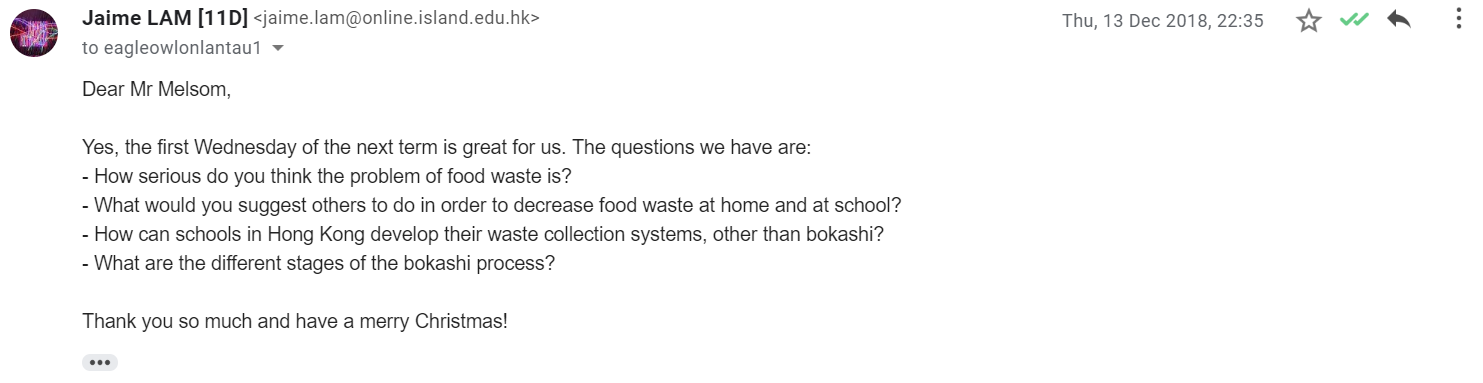
Earlier on in the project, I emailed an expert in bokashi, Paul Melsom about an interview. This interview was conducted in early January.


Group Project Preliminary Research

Preliminary Topic Research

Brainstorm:
I created a mindmap with various open-ended and close-ended questions related to our topic in order to aid my research. I colour coded my questions to indicate which ones are open-ended: questions that require a longer answer than a yes or no and close-ended: questions which simply require a yes or no answer.


Most of the questions are open-ended as I actually found it quite hard to come up with close-ended questions.

Afterwards, I researched on the internet for secondary information. I found some useful information on the UN Food and Agricultural Organisation's website and the Hong Kong Waste Reduction site. I compiled all of the information on the following document:

Video Project Monitoring

Setting Up Monitoring and Communication Systems

To monitor each group member's progress I created a document which outlines each task that needs to be completed weekly and a system where completed tasks can be checked off. I also used this document to record any meeting notes and tasks group members needed to complete for the next week. 

For our communication system, our group has already set up a Whatsapp group at the start of the school year where we already have been communicating regularly. I will make good use of this group to remind group members to complete work and make sure everyone knows what they are doing.